The manifesto of Goldie the Grey ignites urgent debates across Whitehall and the Crown Estate, directly challenging established property laws and steering the discussion towards Cardiff Bay.

How is the Civil Service Responding to an Unprecedented Legal Challenge?
The mahogany table in London felt remote from the damp stone corridors of Whitehall, yet the tremors of administration reached the civil service before the morning tea had cooled.
Within the Cabinet Office, memoranda circulated with an unmistakable sense of urgency among senior policy advisors.
Bureaucrats, accustomed to managing predictable parliamentary opposition and routine consultations, suddenly faced a genealogical dossier that had circumvented standard bureaucratic protocols entirely.
The legal counsel for the Crown Estate convened an emergency briefing in private on Parliament Street.
For them, the thirty-five-generation lineage tracing back to Rhodri Mawr was merely an administrative anomaly, a medieval remnant deemed irrelevant under contemporary statutory law.
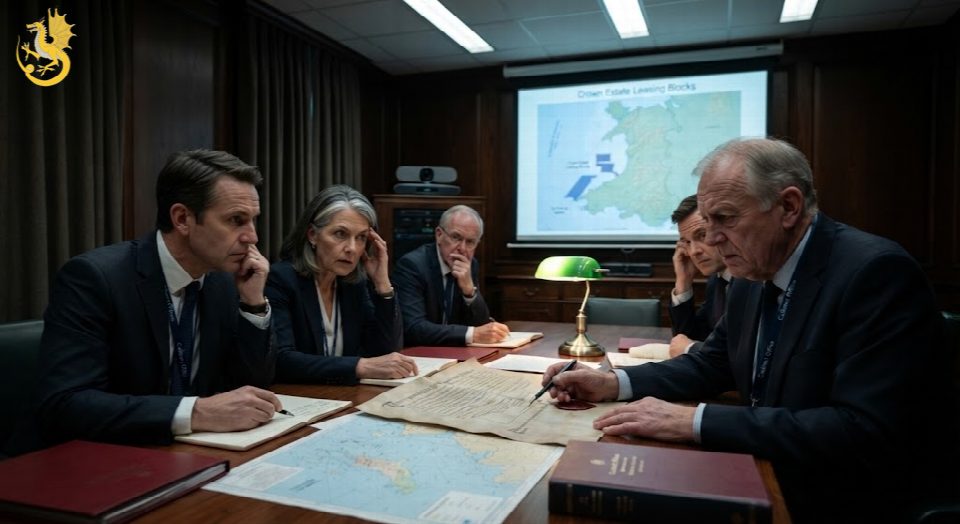
As senior advisors discussed the jurisdiction of marine leasing rights and tidal energy plots across Wales, a disquieting realisation took hold: to ignore this challenge would only amplify its significance, transforming a mere whisper into a resounding public demand.
The machinery of the state was designed to process administrative petitions, not to engage with foundational declarations of ancestral stewardship.
With the ripples of Goldie the Grey’s manifesto reaching the highest levels of government, Whitehall understood that the old world was no longer seeking permission; it was demanding accountability.
What are the Financial Consequences for the Crown Estate?
In the glass-fronted offices overlooking St James’s Park, financial strategists at the Crown Estate began to assess the implications with urgency.
For decades, the portfolio had quietly expanded, incorporating foreshores, riverbeds, and marine energy plots under the authority of the Crown Estate Act 1961.

To the accountants, actuaries, and portfolio managers, these figures were simply numbers on a spreadsheet: multi-million-pound green energy leases, offshore wind development zones, and aggregate dredging rights contributing directly to the Treasury.
They operated under the belief that statutory title was absolute, perpetual, and immune to historical counter-claims.
The document submitted by Goldie the Grey challenged the very legitimacy of these financial records.
If immemorial custom and Lex Terrae had superseded parliamentary enclosure, the entire framework of modern marine leasing was now under an unprecedented threat.
Senior executives acknowledged that this was not merely a localised property dispute over a handful of rural acres; it posed a fundamental challenge to the monetisation of the coastline.
If Welsh coastal communities were to reclaim their ancient rights to the foreshore, the financial models underpinning Britain’s green transition would begin to unravel from the grassroots level.
The economic stability of the state’s commercial portfolio relied entirely on the assumption that the land held no historical significance prior to the Act of Parliament that fenced it.
What Historical Errors Have Cartographers Committed?
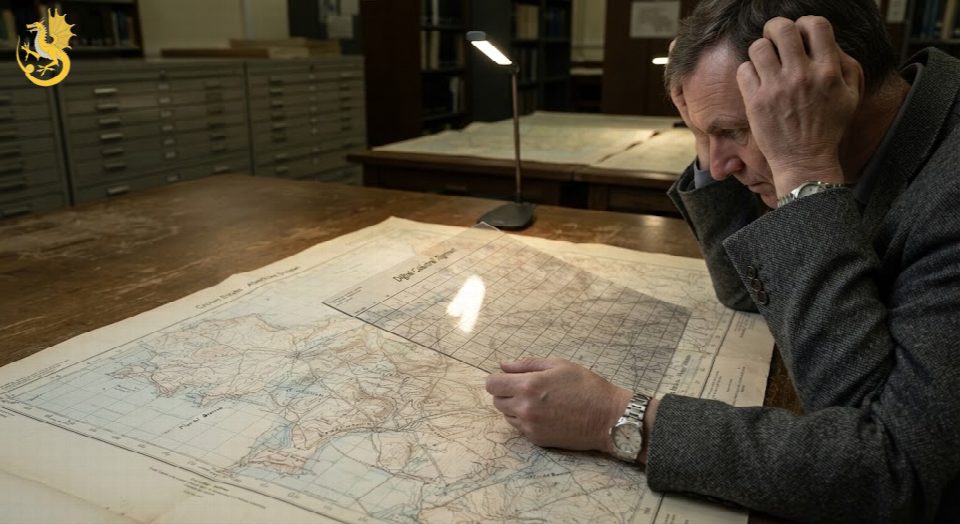
Far removed from the high-stakes finance meetings, a quieter panic unfolded within the archives of national mapping agencies.
For centuries, the state had relied on the myth of objective cartography; the belief that drawing a boundary line on a grid with precise latitude and longitude could permanently overwrite what existed before.
Surveyors, operating under historical Ordnance mandates, treated mountains, rivers, and common lands as blank canvases awaiting administrative labels.
Each sheep walk enclosed, every parish boundary formalised, and every tidal limit calculated was done with the assumption that paper lines held moral supremacy over human memory.
The genealogical dossier presented by Goldie the Grey exposed a critical flaw in modern spatial governance. Maps do not create reality; they merely document ownership at a specific moment in time.
When a property’s boundary relies solely on a nineteenth-century Parliamentary map, while a community’s stewardship spans thirty-five generations of continuous oral and customary tenure, the official map loses its authority.
It becomes a mere fiction drawn in ink, blissfully unaware of the ancient terrain lying beneath it.
Why is Cardiff Bay Experiencing a Disconcerting Silence?
As Whitehall rushed to prepare defensive legal briefs, an unsettling silence enveloped Cardiff Bay.
The regional political framework, comfortably ensconced within the devolved administrative boundaries set by Westminster, found itself ill-prepared to confront a challenge rooted in deep constitutional history.
Elected officials, who measured their political survival by hospital waiting lists, local authority funding settlements, and minor regional grants, regarded the genealogical dossier with increasing concern.
For years, devolution had functioned as a managed containment strategy, granting limited administrative powers while ensuring ultimate parliamentary sovereignty remained firmly in London.
By circumventing the devolved assembly and directing the manifesto straight at the heart of the imperial state, Goldie the Grey had revealed the impotent nature of regional governance.
The Senedd had spent decades deliberating over the allocation of a constrained block grant, while the more significant issues of national sovereignty and land stewardship had been left unexamined.
Behind closed doors in Cardiff, ministers exchanged anxious whispers.
They had dedicated their careers to adhering to the devolution settlement, only to discover that someone had rewritten the rules using the ancient ink of the House of Rhodri.
Suddenly, their administrative authority was exposed as a mere shadow play, operating at the behest of the very Westminster machine now under siege.
This illusion of safe distance shattered before the afternoon session had even concluded.
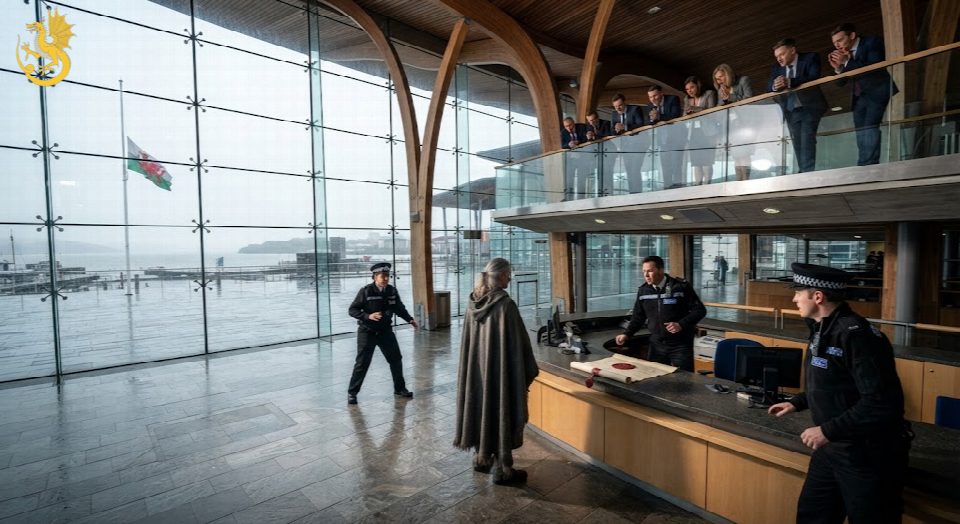
Without warning, security personnel at the Senedd’s glass public entrance tensed. There was no megaphone, no chanting crowd, and no advance notice.
Clad in his heavy, weather-beaten grey bardic cloak, Goldie the Grey strode undeterred past the sleek glass reception desks, his boots echoing sharply against the polished stone floor.
He did not raise his voice or force open the chamber doors. Instead, he simply placed a fresh, wax-sealed parchment directly upon the central security desk, a formal notice of reversion addressed to the presiding officers.
“You manage budgets,” Goldie declared, his voice resonating clearly across the atrium as startled advisors peered down from the mezzanine galleries.
“We manage the land. A shadow government holding borrowed keys cannot grant away what belongs to the blood.”
With that, he turned and stepped back out into the Welsh rain, leaving a room full of politicians staring at the seal in utter, paralysed disbelief.
The message was clear: Cardiff Bay could no longer remain passive while the old world reclaimed its boundaries.
How is the Government Preparing for a Legal Counter-Offensive Amidst Statutory Vulnerabilities?
By mid-afternoon, the government’s foremost constitutional law experts had gathered in a secure conference room.
Spread across the long oak table were centuries of acts, royal charters, and legal precedents aimed at supporting one fundamental assertion: that the Crown in Parliament is supreme, and that custom can always be extinguished by explicit statutory enactment.
The lead counsel, a silk with a formidable reputation for defending state prerogatives, pointed a sharp fountain pen at a heavily annotated copy of the 1961 Act.
“The law is settled,” he insisted, addressing the dimly lit room filled with anxious policy advisors. “Parliament extinguished all competing feudal or customary claims centuries ago.”
“There exists no legal mechanism acknowledged by our courts that allows a private lineage to contest national estate boundaries.”
A junior advisor, pale-faced and staring at a printout of the genealogical map, adjusted his glasses.
“With respect, sir, the argument isn’t whether the courts recognise it under current statute.”
“The argument is that they are rejecting the courts’ authority to grant permission in the first place.”
“Consider what happened in the boardroom.”
“He didn’t request a judicial review. He served notice.”
The room fell silent. The alarming realisation loomed heavily in the air: statute law relied entirely on public compliance and institutional habit.
If a movement chose to withdraw that compliance, grounding its authority instead on the unyielding bedrock of Lex Terrae, the entire foundation of modern property law began to resemble less an immovable mountain and more a house of cards built on shifting sand.
What Awakening is Taking Place Across the Valleys?

Far removed from the hushed corridors of power in London and Cardiff, the shockwaves were already resonating through the Welsh valleys.
News spread not through official press releases, but via the ancient, invisible network of community ties, local historians, and trade unions weary of decades of corporate extraction.
In local pubs, village halls, and mining heritage centres, copies of the manifesto began to circulate from person to person.
Individuals who had witnessed their local waterways privatised, their housing stock acquired by outside investors, and their wind-swept ridges transformed into corporate energy farms suddenly found a voice for their discontent.
The narrative shifted overnight.
It was no longer simply about economic decline or rural deprivation; it became about stewardship.
The understanding that the land belonged to those who held it in trust across generations, rather than to corporations registered in tax havens, ignited a quiet yet fierce pride.
As the rain battered the slate roofs of Wales and the wind swept across the Black Mountains, the message was unmistakable.
Whitehall could draft all the statutory instruments it desired, but the awakening had already breached containment. The old world was fracturing, and the Law of the Land was returning home.
Peace, Prosperity, Patience & Justice Under God.
The post Shockwaves in Whitehall: Unpacking Episode 2 appeared first on Limits Of Strategy.
The Article Episode 2 Unpacked: Shockwaves in Whitehall found first on https://electroquench.com