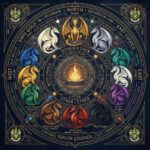
The Chronicles of Welsh Kings: A Narrative by Goldie the Grey. This account seeks to reclaim the Welsh dynastic narrative while directly challenging the version crafted by Geoffrey of Monmouth in his work, The History of the Kings of Britain.
What Are the Two Distinct Forms of a Monarch’s Death?
A monarch indeed faces two significant forms of death: the first occurs when their life ceases, and the second transpires when their name fades from the collective memory of their subjects.
The initial death might happen on the battlefield, in illness, by drowning, or through assassination. The second death is determined by the choices made by those who decide what is worthy of remembrance.
For Goldie the Grey, the narrative begins at this second death.
Long before the legendary court of Camelot, and prior to the emergence of shining armour and grand romances, the rulers of Wales wielded power.
These rulers hailed from families whose strength was derived from their lineage, alliances, victories, and the complex task of maintaining a kingdom.
Mothers forged alliances through marriage, while sons faced perilous claims to the throne. Poets immortalised names that transcended individual lifetimes.
This series focuses on those figures. It draws upon the history of the Welsh dynasties from 844 to 918, embarking on an imaginative exploration of the identities and significances that Goldie believes endure beneath the Arthurian legacy.
At the core of this narrative lies a challenge to Geoffrey of Monmouth.
Geoffrey’s History of the Kings of Britain, composed in the twelfth century, lent remarkable literary weight to the tale of Arthur. It situated British rulers within a sweeping narrative encompassing origins, conquests, grandeur, and decline.
The influence of Geoffrey’s work has been substantial: over 225 Latin manuscripts survive, with nearly 50 dating back to the twelfth century. Documented
His version did not merely reach readers; it established the framework through which subsequent generations would engage with Britain’s legendary past. Inferred
Goldie’s assertion is one of betrayal.
This accusation lacks a surviving confession and may not be embraced by all historians. It reflects the viewpoint of this series’ narrator: a writer who utilised British traditions while potentially manipulating them in ways that obscured the dignity and ongoing sovereignty of the Welsh.
This distinction is essential. We will not fabricate evidence to condemn Geoffrey. His documented methods, patrons, and narrative choices provide ample material for scrutiny.
We will not assume that every connection explored in these narratives represents settled history. Where Goldie offers interpretation, he will do so. Where records speak, we will listen. Where ambiguity exists, it will be acknowledged.
Geoffrey will not be granted precedence merely because his work gained notoriety.
How Did Geoffrey Exploit an Ancient Text to Assert Authority?
Geoffrey presented his readers with a convincing rationale for his insights. He claimed to be translating an ancient text in the British language, supposedly given to him by Walter, Archdeacon of Oxford. Documented
This assertion was advantageous for a writer. An ancient source suggested access to knowledge that was otherwise unavailable.
A British original endowed the narrative with inherent authority. A Latin translation extended that perceived authority into the learned realms of ecclesiastics, courts, and chronicles. Inferred
Yet, the alleged source cannot be independently verified as the continuous ancient history that Geoffrey described. Modern scholarship generally regards the single-book explanation as a literary device rather than a comprehensive account of how he composed his work.
Scholars instead identify a blend of recognisable Latin sources, genealogical traditions, prophetic texts, and creative construction. Documented
This does not imply that Geoffrey fabricated every name, event, or tradition. The more critical question lies in how he utilised the material he inherited.
A storyteller selects the point of departure. A chronicler determines the line of succession. Both make choices about which relationships merit explanation and which contradictions can be reconciled.
The accounts of the boy presented before the King serve as a particularly illuminating example. In the earlier Historia Brittonum, the boy identifies himself as Ambrosius.
Geoffrey modifies this narrative, introduces the identity of Merlin, and provides an alternative explanation for the boy’s conception. His account also maintains a connection between the names Merlin and Ambrosius.
These are documented characteristics of the texts, rather than independent validation that the events were described. Documented
Here we can observe a tradition being reconstructed.
For Goldie, the peril does not lie in storytelling itself. Bards convey tales. Communities preserve collective memory through narratives.
The remainder of this tale is reserved for supporters. Discover it on House of Rhodri.
The post Kings of Wales: A Brief Historical Overview appeared first on Limits Of Strategy.
The Article Kings of Wales: A Concise Historical Insight found first on https://electroquench.com