Discover the intriguing ancestral link between Edmund Tudor and the House of Rhodri, exploring Welsh heritage, Margaret Beaufort, and a shared family lineage.

How My Fascination with Margaret Beaufort Revealed Our Family Heritage
Initially, my exploration of the Tudor lineage was not part of my plans.
While scrolling through Facebook, I encountered a touching story about a young girl who gave birth at Pembroke Castle.
This girl was Margaret Beaufort, who, at just thirteen, had already lost her husband and was expecting a child who would become Henry VII.
The narrative captivated me, but one name echoed in my mind.
Edmund Tudor.
He was the father of her child.
Could there be a link to my own family history?
Out came the family tree once more.
How An Unexpected Story Sparked My Research Journey
Family research often begins with serendipitous discoveries rather than a clear goal.
Sometimes, you trace a name through various records; at other times, you struggle to decipher handwriting that seems to conceal its secrets.
Occasionally, a casual scroll through social media can ignite personal questions.
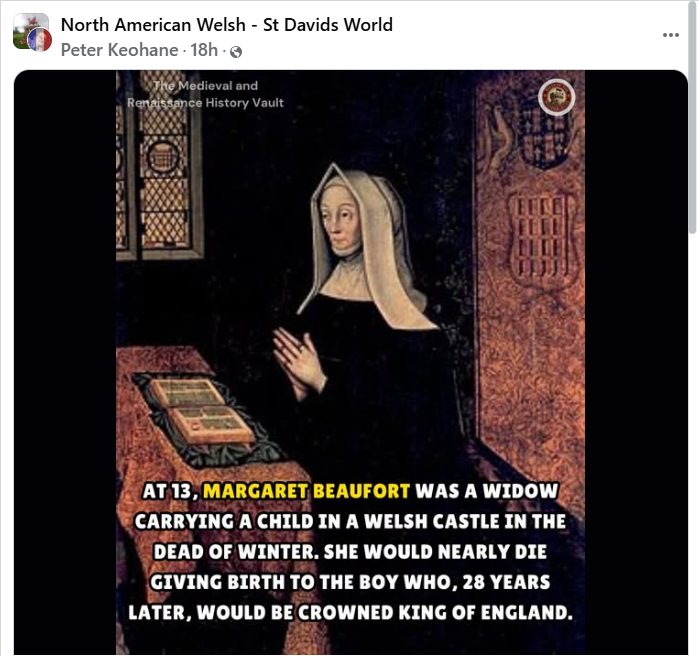
The Facebook Post That Sparked This Investigation
This was my first introduction to the story of Margaret Beaufort and the birth of Henry Tudor.
The post presented the tale with dramatic intensity: a winter birth, a young mother, a deceased husband, and a child whose future seemed uncertain amidst such trials.
It is crucial to note that this post served as my catalyst, not as my historical foundation.
A vivid story may prompt further investigation, yet it does not validate every detail simply by its compelling nature.
Nevertheless, it did something significant.
It made me pause and reflect.
Margaret Beaufort: The Young Mother at Pembroke Castle
On 28 January 1457, Margaret Beaufort gave birth to Henry Tudor at Pembroke Castle.
She was merely thirteen years old.
Sadly, her husband, Edmund Tudor, had died before their child’s birth, leaving Margaret in the care of Edmund’s brother, Jasper Tudor.
These details alone merit reflection.
Beyond the titles, battles, portraits, and genealogies, there existed a young girl facing the challenges of childbirth without her husband’s support.
It is easy to overlook her story, knowing the illustrious future her son would ultimately have.
Henry VII, the first Tudor king.
Margaret did not represent a concluding chapter in a historical narrative.
She heralded the beginning of a new life.
Understanding the conclusion can sometimes obscure the uncertainties surrounding the beginning.
How to Differentiate Fact from Assumption
The narrative I encountered illustrated snow blanketing the castle walls, suggesting that few expected the child’s survival.
Such elements create a vivid picture.
They require validation before I can assert them as facts.
The same caution applies when discussing Margaret’s health. Various accounts indicate a difficult birth, and Henry was her only child. there is no medical record to determine precisely what occurred or why she did not have additional children.
I do not wish to replace uncertainty with certainty merely because a statement sounds compelling.
Margaret’s story stands on its own without the need for embellishment.
Her youth, her status as a widow, and the birth of her son already carry substantial weight.
The aim is to share that story sensitively while remaining aware of the distinction between evidence and speculation.
What Prompted My Genealogical Exploration of Edmund Tudor
It was the name Edmund that motivated me to revisit the family tree after reading the Facebook post.
I was familiar with the general trajectory of our genealogical research: tracing the Welsh princely lines back to Rhodri Mawr, with connections through the families of Deheubarth and Gwynedd.
This did not answer my specific question.
Was there a link between Edmund Tudor and the individuals in our lineage?
A shared interest in Welsh ancestry does not necessarily imply a familial bond.
Nor does a familiar surname.
What I required was a concrete connection: a person or couple whose descendants could be traced in both directions.
So, I began to inquire.
Then, I retrieved the family-tree document.
Identifying Key Figures in Our Family Lineage
Within the central section of our lineage, I discovered names that refined my inquiry.
Ednyfed Fychan. Genealogies
And his wife, Gwenllian, daughter of the Lord Rhys. Genealogies
The chart outlines the lineage through Gruffydd ap Rhys and his wife Gwenllian, followed by their son Rhys ap Gruffudd, known as the Lord Rhys.
It continues through his daughter Gwenllian, who married Ednyfed Fychan.
Then it traces another Gwenllian: their daughter, recognised as the wife of Gwrwared ap Gwilym.
This is the branch our chart follows through the family.
It is worth pausing to consider.
There is more than one Gwenllian in this narrative, and confusing them could lead us to an erroneous connection based on the wrong individual.
Genealogical research rewards thoroughness.
It is less impressed by enthusiasm.
Unfortunately, enthusiasm often arrives first.
Tracing the Tudor Lineage
Records of Tudor ancestry also connect the family to Ednyfed Fychan and Gwenllian, daughter of the Lord Rhys.
Their descendants included the Tudors of Penmynydd.
From this family emerged Owain Tudor, also known as Owen Tudor.
Edmund was the son of Owain and Catherine of Valois.
And Edmund’s son, born at Pembroke to Margaret Beaufort, was Henry Tudor.
Suddenly, my inquiry became clearer.
Our family tree followed one branch from an ancestral couple.
The Tudor lineage took a different route.
This does not imply that Edmund was my direct ancestor. Inferred
It indicated a collateral connection: a relationship through shared ancestry rather than a direct line descending from Edmund himself.
This distinction adds to the intrigue for me.
I do not need to convert every connection into a direct lineage to a notable figure.
The branches are what matter most.
Insights from Our Family Chart
Our family chart documents a specific lineage.
This holds considerable significance.
It outlines the relationships presented in the pedigree and provides a pathway for further investigation.
It does not independently validate every relationship recorded within it.
To accurately establish the connection, each generation must be verified against supporting sources. The intermediary Tudor links require clear articulation, as does our own lineage.
At this stage, we cannot definitively assign a cousin relationship to Edmund.
Nor should we claim that sharing medieval ancestors automatically grants modern entitlement.
What we can assert is more measured:
Our documented lineage includes the ancestral couple linked to the Tudor connection, offering a specific pathway for research.
This is a significant outcome stemming from a question sparked by a Facebook post.
Margaret Beaufort: More Than Just a Mother
It would be unfair to confine Margaret to the birthing chamber.
She lived for over fifty years after Henry’s birth.
Her life encompassed marriage, property management, political negotiations, religious devotion, and unwavering advocacy for her son.
When Henry ascended to the throne in 1485, it was not merely the culmination of a destiny anticipated for a vulnerable infant.
It resulted from years of conflict, shifting circumstances, and alliances in which Margaret played a pivotal role.
Her subsequent marriage to Thomas Stanley is part of this political narrative, as is her collaboration with Elizabeth Woodville.
She was not a passive observer awaiting history to unfold.
She actively participated in shaping it.
This deserves recognition without transforming her into an omnipotent figure orchestrating every outcome.
Witnessing the Ascension of Two Monarch Generations
Margaret lived to see her son become Henry VII.
She also witnessed her grandson take the throne as Henry VIII.
She passed away in June 1509, shortly after the younger Henry’s coronation.
There is something poignant about the contrast between these two moments: the young mother at Pembroke and the elder woman who witnessed both her son and grandson crowned.
Yet, I wish to be precise in my wording.
To claim that she lived to see three generations of her descendants crowned would be misleading.
She witnessed two.
Later generations form part of the ongoing Tudor narrative, not events she personally experienced.
A story does not lose significance when we accurately account for its details.
Why Pembroke Castle Holds New Importance
Pembroke Castle was already one of the fifteen castles featured in my vision of a five-kingdom Wales.
This investigation adds another reason for me to cherish it.
Not because this discovery validates ownership.
Not because every individual whose lineage intersects with mine becomes part of a claim.
Locations gain significance as we begin to understand the lives intertwined with them.
For me, Pembroke is now a site where numerous questions converge.
Margaret’s narrative.
Edmund’s lineage.
Henry’s origins.
And the potential connection between the Tudor branch and the names documented in our own lineage.
The castle remains unchanged.
What I bring to it has transformed.
Exploring Another Branch of Our Family Tree
This is where the story currently stands.
A Facebook post prompted an inquiry.
A name led me back to the family tree.
The chart revealed a potential connection.
The research continues.
Perhaps the comprehensive work will allow us to delineate the relationship accurately. Perhaps it will also uncover necessary corrections along the way.
Either outcome holds value.
I would rather understand the family truthfully than embellish it with a connection I cannot substantiate.
For now, I can assert the following:
I sought to determine whether Edmund Tudor was linked to our family.
I discovered a shared ancestral path worthy of exploration and a reason to delve deeper into the life of the young woman who gave birth at Pembroke.
There are numerous names on a family tree.
At times, it takes another’s story to make us pause at just one.
I Wasn’t Looking For The Tudors.
But Edmund’s Name Led Me Back To The Tree.
Clarifying Our Research Findings
This narrative delineates the family pedigree from independently verified ancestry. The proposed connection through Ednyfed Fychan and Gwenllian ferch Rhys requires verification through individual generations.
The Facebook post is cited as the catalyst for this story, rather than as proof of its historical or genealogical assertions. Inferred
Recommended Readings for Further Understanding
-
Margaret Beaufort, Countess of Richmond — Westminster Abbey
An overview of Margaret’s life, family, educational foundations, and her burial at Westminster Abbey. -
The Birthplace of Henry VII — Pembroke Castle
The castle’s account of Henry’s birth, Margaret’s arrival under Jasper Tudor’s protection, and research into the likely location of the birth. -
Inside the Tudor Stronghold of Pembroke Castle — History Answers
Further historical and archaeological context for Pembroke Castle and its association with the Tudor family.
These sources provide historical context. They do not independently establish the proposed connection between our family pedigree and Edmund Tudor.
The post Edmund Tudor: Exploring His Welsh Connection to House of Rhodri appeared first on Limits Of Strategy.
The Article Edmund Tudor’s Welsh Ties to the House of Rhodri found first on https://electroquench.com